11 days: 7-day climb + 4 hotel nights — US$ 1,999 all-in
Do you want to climb Africa's highest mountain? With Expedition Kilimanjaro you'll trek in 7 days via the Machame Route to the legendary summit. You'll start in the green rainforest of northeastern Tanzania and steadily ascend to a world of glaciers and eternal snow all the way to Uhuru Peak (5,895 m).
Each stage reveals new landscapes – from tropical green to moon-like high plains – and gives you that indescribable feeling of freedom on the roof of Africa.
Whether you're an experienced trekker or planning your first major mountain journey, we ensure a safe, enjoyable and unforgettable experience: professional (English-speaking) guides, personal preparation and a complete package at a transparent price.
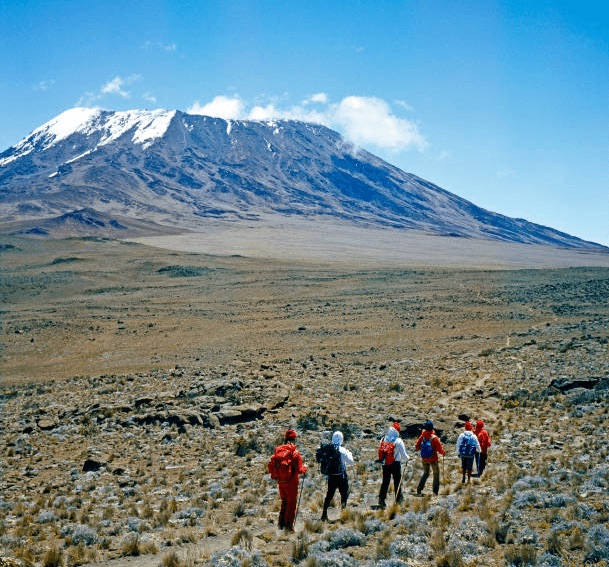
5,895 meters. The roof of Africa. Your achievement.
Mount Kilimanjaro is not an ordinary hike, it's a once-in-a-lifetime adventure. From green rainforests you walk to a world of glaciers and eternal snow, all the way to the mythical summit at 5,895 meters, the roof of Africa!
"Can you already see yourself standing here?"
Since 2008 Ramon Stoppelenburg has organized a fully arranged 11-day program: 7 days Machame Route + 4 hotel nights in Arusha (two days before and after the climb). We work with small groups (max. 12) for personal attention and safety. Our certified Tanzanian guides have years of experience and guide you with calm, knowledge and enthusiastic humor to the summit.
Maximum 12 participants for focus and safety
Certified, first aid and rescue training
What guides actually do on the mountain isn’t always visible. This is what a day in the life of a Kilimanjaro guide looks like
Permits, meals, porters and transfers included
Everything taken care of: from the atmospheric hotel in Arusha to the breathtaking climb
No surprises afterwards
Read all about this on the page about travel dates and the price
The Machame Route offers an ideal mix of challenge, good acclimatization and views. You walk through dense jungle, across the Shira plateau and along the Barranco valley. On the night of day 6 to 7 you undertake the walk to the summit, so that you stand on Uhuru Peak around sunrise.
View the complete day-by-day schedule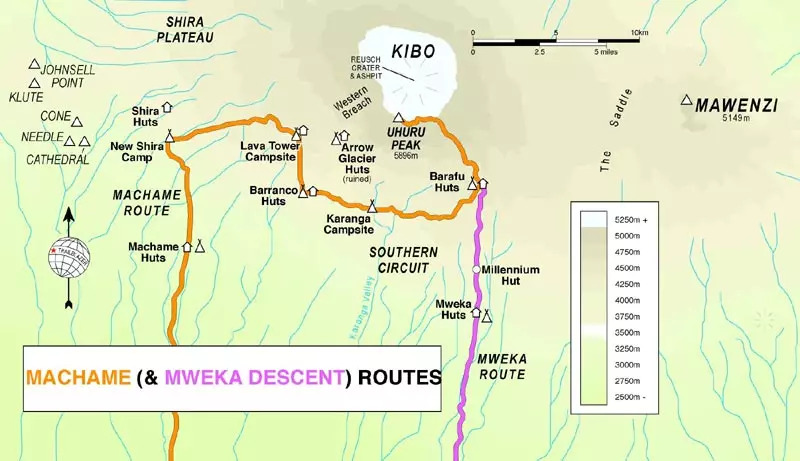
The bonds you form on Kilimanjaro last a lifetime
For USD 1,999 (approximately €1,700)
EVERYTHING is arranged for a successful climb.
International flights are not included; view our flight tips here
Success rate ±85–90% with experienced guides and optimal acclimatization
December 25, 2026 – January 4, 2027
Count down on the summit!
January 16 – 26
February 14 – 28
✓ 3 participants reserved
View the complete overview of all departure dates, the best time to travel and what's included in the price.
Reservation form View all dates & prices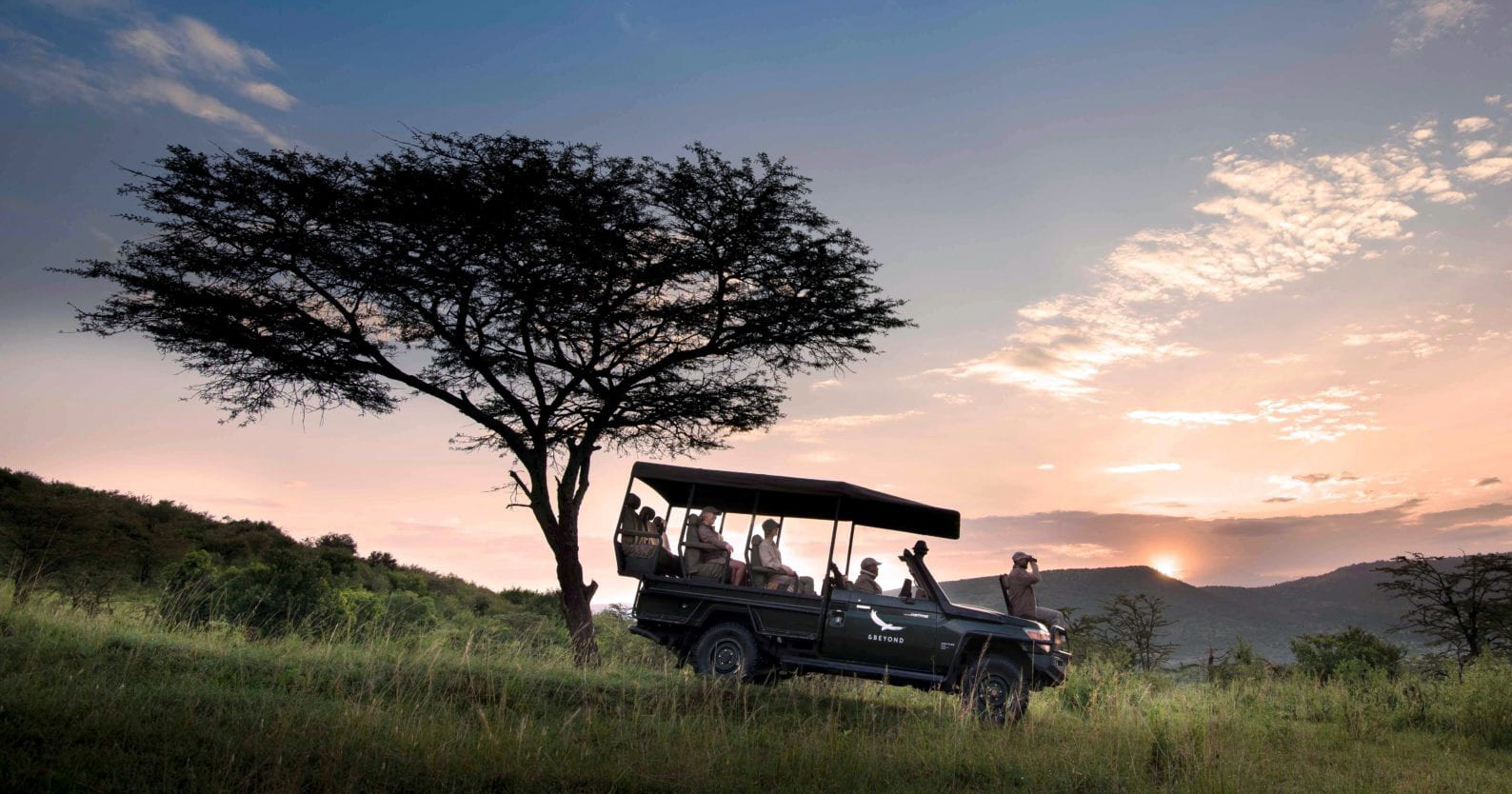
Combine your Kilimanjaro trek with an unforgettable safari in Tanzania. Visit the Serengeti or the Ngorongoro Crater and spot lions, elephants and giraffes. Choose a day trip or multi-day package – we'll arrange it seamlessly following your expedition.
View our safari options
The best option is to fly directly to Kilimanjaro International Airport for maximum convenience. Round-trip flights from Amsterdam often cost around €750. Alternative: fly to Nairobi (Kenya) and take a shuttle bus to Arusha (approx. $70 round trip). Turkish Airlines also offers competitive rates with a direct route Istanbul → Kilimanjaro.
More about flying to Tanzania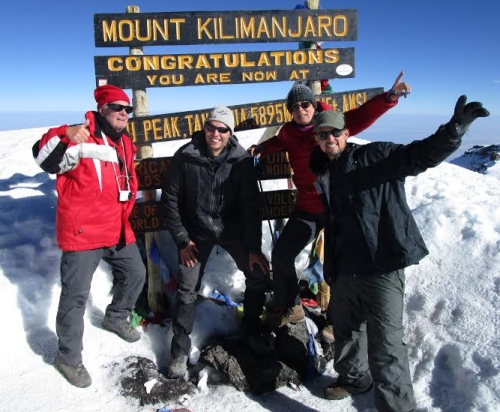
"What an incredible week we had. We suffered, laughed, got emotional, ate well, saw beautiful things, complained, and had tremendous respect for our guides Joseph, John and Robert and the rest of the support team. A week we'll never forget!"
Together with Bart-Jan Schoone, Bart Schoone and Bas Stuurwold
Everything you want to know about the expedition, the preparation and what to expect.
You don't need to be a mountaineer. Kilimanjaro is physically demanding but technically straightforward. If you can walk for 2–3 hours and are willing to train, you can handle this adventure. Most people who reach the summit aren't athletes — they're people with healthy perseverance.
You need a basic level of fitness: being able to move 6–8 hours a day, climb stairs without difficulty, and exercise or walk regularly. The most important factor is endurance, not strength.
Our success rate is around 85–90% — higher than average on Kilimanjaro. That's thanks to the 7-day route (better acclimatization), small groups and experienced guides. But: no one can guarantee 100%. Altitude remains unpredictable.
Most people experience mild symptoms. One person might get a slight headache, another might feel nauseous. That's normal — it means your body is adapting to the altitude. Our guides monitor this continuously and intervene when necessary.
We usually don't recommend it. The route already provides good acclimatization, and it can mask symptoms. Always consult your doctor first.
You descend with an assistant guide. If you're with a group, the rest continues. That's not failure — it's a smart decision. Many people come back later and make it.
It's mostly a mental challenge. You walk slowly ("pole pole"), but altitude makes everything harder and summit night is intense: 10–12 hours of walking. It's not a sprint. It's getting up every day and pushing on.
Because it simply works best. High success rate, good acclimatization ("climb high, sleep low"), the most varied landscapes. After years of experience, this is the route Expedition Kilimanjaro fully stands behind.
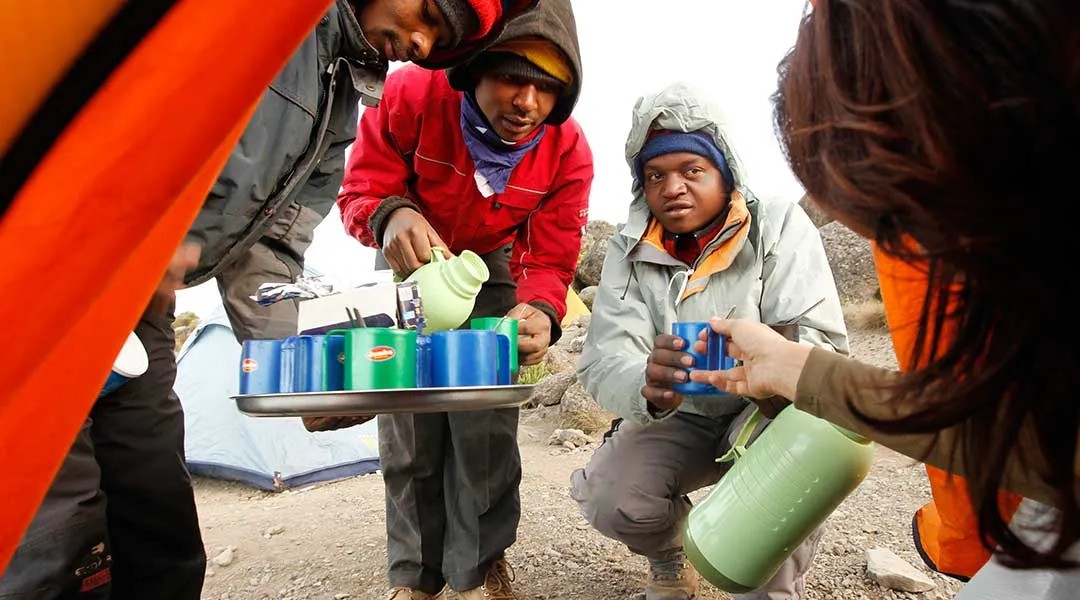
You wake up around 06:30, have breakfast, and start walking around 08:00. You usually arrive at camp in the early afternoon for some rest, then dinner and sleep. Summit night is different: depart around midnight, reach the top at sunrise.
The best months are January–March and June–October. Weather is most stable then and you have the best chance of clear views. January–March is quieter. June–October is drier and more popular. More info on the page with all information about dates and prices.

Everything you need on the mountain: guides and team, porters, all meals, tents and camping equipment, park fees and transfers, plus hotel before and after the climb. Not included: flights, travel insurance, personal gear and tips.
The operation is deliberately kept small and efficient. No expensive office, no large marketing campaigns,
no middlemen driving up the price. The bulk of the budget goes directly to the expedition itself: experienced guides,
fair wages for porters and quality support on the mountain.
Rather than focusing on maximum profit, the emphasis is on
a safe, well-organized climb and on supporting initiatives such as the Tanzania Porters Association and the
Tanzania Women Guides Foundation (TWGF). That benefits not only the participant, but also the local community in Tanzania.
Around $400–500 in total. The largest part is tips ($250–350) — the team works extremely hard and this is an important supplement to their income. The rest goes on drinks, souvenirs and small expenses.
Yes, no booking can be made without travel insurance. Your policy must at minimum cover: medical costs, high-altitude evacuation, and trekking up to 6,000 meters. Expedition Kilimanjaro may request documentation for verification.
Fill in the reservation form. This is completely non-binding. You'll receive confirmation that your date is available — only then can you finalize your booking. Once payment is made, your booking is confirmed.
Yes, but conditions apply depending on how late you cancel. You'll find these in the terms and conditions. That's exactly why good travel insurance is essential.
Ideally 6–10 weeks. Focus on hiking, cardio and sustained effort. No extreme training needed, but consistency matters. And break in your hiking boots: at least 80–100 km before you depart.
The essentials: good (broken-in) hiking boots, warm layered clothing, sleeping bag and day pack. Many items can also be rented locally. You only carry a day pack of 3–5 kg — the rest (max 15 kg) is carried by porters.
Yes, especially during summit night. Temperatures can drop to -10 to -20°C at night, but during the day you can be hiking in warm sunshine in shorts. Dress in layers — good clothing is crucial.
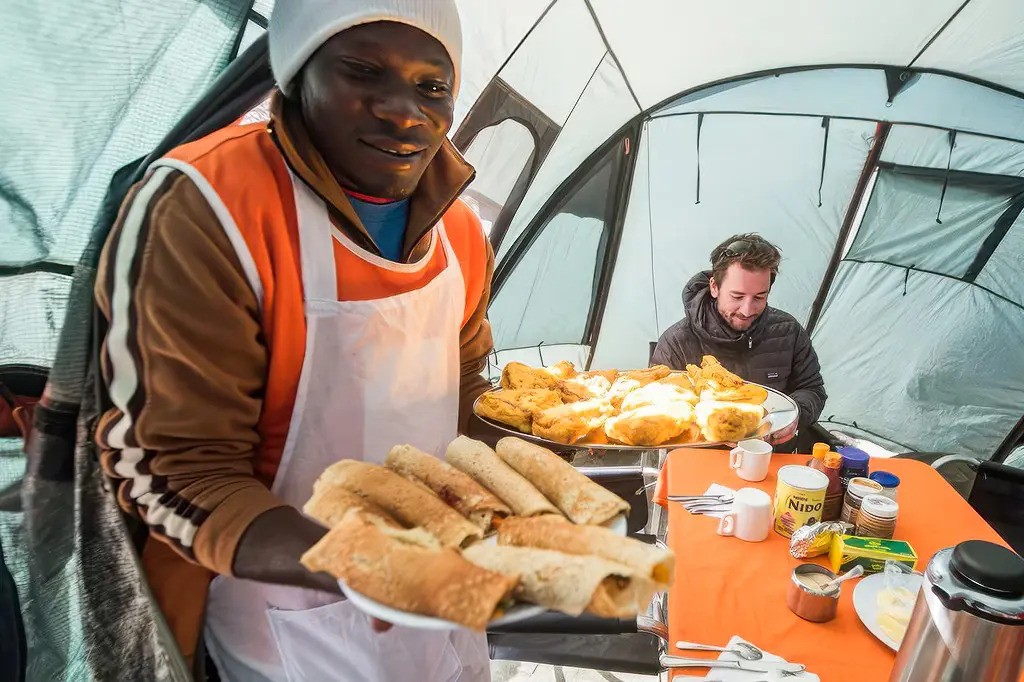
You get three meals a day — the food is good and plentiful, though your appetite decreases at altitude. Washing is done with water and wipes (a proper shower afterwards feels like pure luxury). There's a private toilet tent: not fancy, but perfectly manageable.
Barely. Very occasionally people get online during the climb, but don't count on it. You're offline for a while. And that turns out to be surprisingly pleasant.
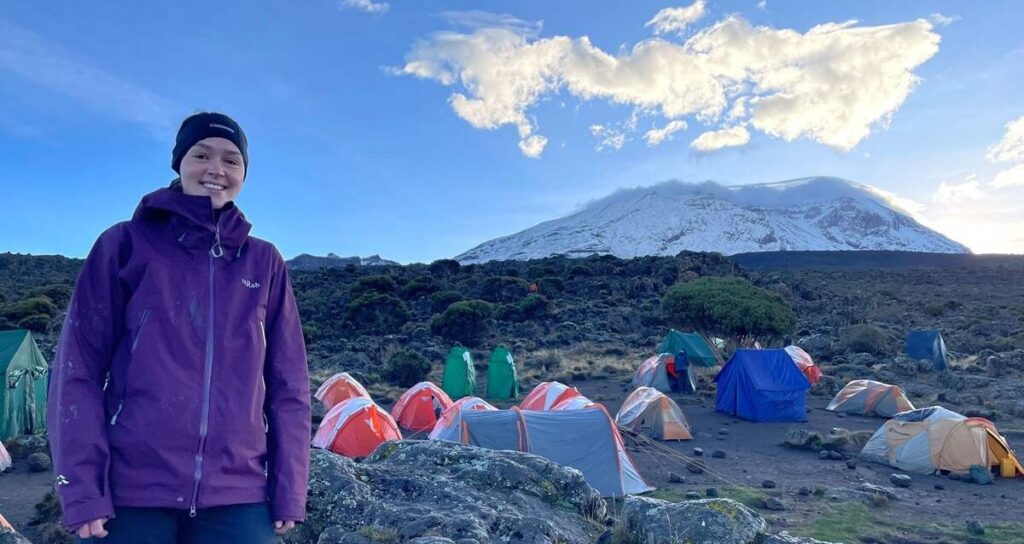 Yes. Many people travel solo and join a group, or opt for a private expedition (the price stays the same!).
But you're never truly alone. From the moment you arrive, you're supported by an experienced team of guides, porters and crew who are there for you at all times.
During the climb there's always someone nearby monitoring your pace, checking your health and stepping in when needed. You're never on your own for a single moment.
Yes. Many people travel solo and join a group, or opt for a private expedition (the price stays the same!).
But you're never truly alone. From the moment you arrive, you're supported by an experienced team of guides, porters and crew who are there for you at all times.
During the climb there's always someone nearby monitoring your pace, checking your health and stepping in when needed. You're never on your own for a single moment.
Yes. Not because it's easy — precisely because it isn't. It does something to you. And that's different for everyone. But you carry it with you for the rest of your life.
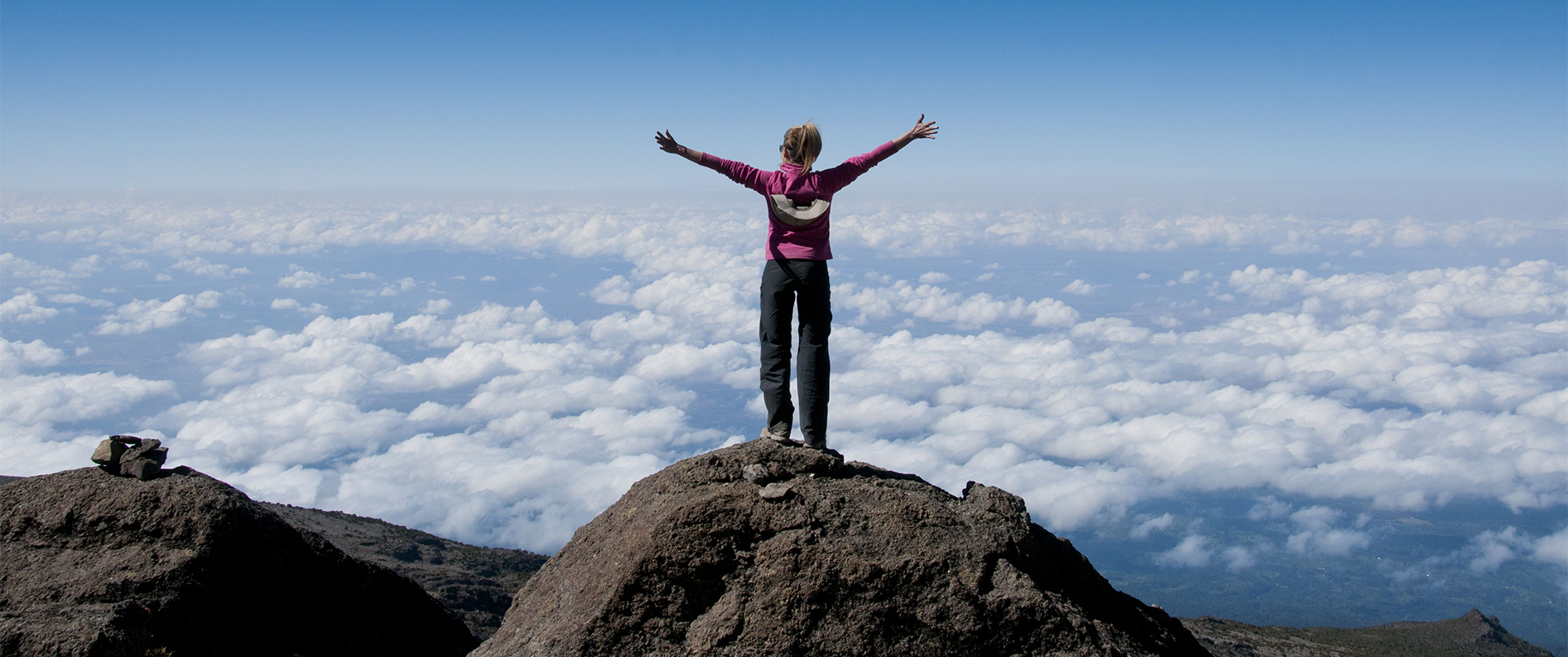
You've been looking around. Maybe you're still hesitating.
Or wondering whether this is really something for you.
But something brought you here. Something that says you want to do this. Not because it's easy, but because it's extraordinary.
Most people keep hesitating. A few decide to go.
The question isn't whether you can.
The question is: are you going to?
Kilimanjaro is a challenge. But with the right preparation and guidance it's achievable — even without mountain experience.
Eleven days of pure adventure and personal growth

Travel specialist, writer, photographer and marketing professional, currently based in Phnom Penh, Cambodia. Has been climbing Kilimanjaro regularly since June 2008.
More about Ramon