
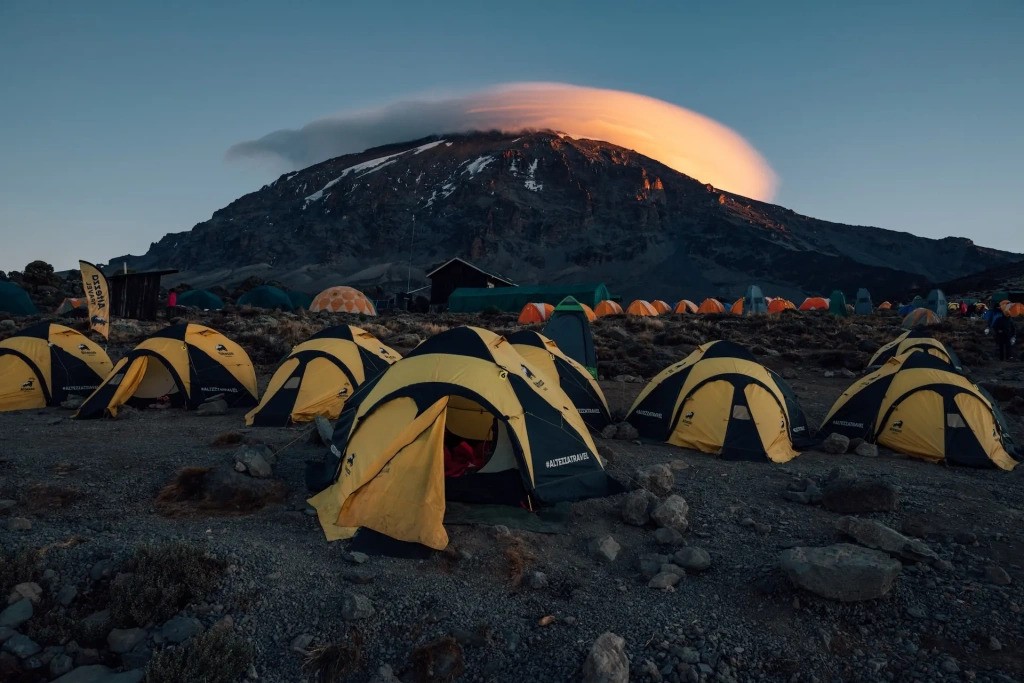
On Day 8 we made it all the way from Karanga Camp to end up at Barafu Camp in the early afternoon. That was a nice 4 hour hike, with a lunch break. What happens next is strange, tea time with popcorn is replaced by an instant full dinner in the mess tent. That's an early dinner and then the guide says "after dinner you all go to bed, because just before midnight we head up to the summit".
We do as we are told, enjoy French fries and fresh cooked greens for dinner, at 4600 meters altitude, and then head to our tents. While the sun is still out, we need to sleep. It's all good, because the altitude plays with us. We are tired anyway. Uhuru Peak, we are coming for you!
The tents go quiet. Most people lie still in their sleeping bags, fully clothed, boots already on, staring at the fabric above them and listening to the wind move across the mountain.
Day 8 of the Machame Route is unlike any other day on the mountain. It begins in darkness and cold, passes through silence and effort and something approaching wonder, and ends with the kind of tiredness that doesn't feel bad at all. What happens in between is genuinely difficult to put into words — but the people who've been through it tend to agree on one thing: it stays with you.
The Hours Before
Barafu Camp sits at 4,600 metres, high enough that the air already feels thin and the stars already feel close. In the hours before midnight, it's a strange place to be — caught between the days of hiking behind you and the summit that still lies ahead. Some people feel nauseous. Some have a dull headache that's been sitting behind their eyes since the afternoon. Most feel a version of nerves that's hard to name exactly, somewhere between excitement and dread, and that they've never quite felt before in quite this way.
What many climbers say afterwards is that those waiting hours were the hardest part of the whole expedition — harder than the Barranco Wall, harder than the altitude days, harder even than the climb itself. The mind has too much time and too little oxygen, and it tends to fill the space with questions that have no useful answers yet.
🧠 What experienced climbers say
The waiting is part of it. Stay warm, eat something small even if you don't feel like it, and let the nerves be there without trying to talk yourself out of them. Almost everyone who has stood at Uhuru Peak felt exactly what you're feeling in that tent at Barafu. The mountain doesn't ask you to be fearless. It only asks you to start walking.
The First Steps in the Dark
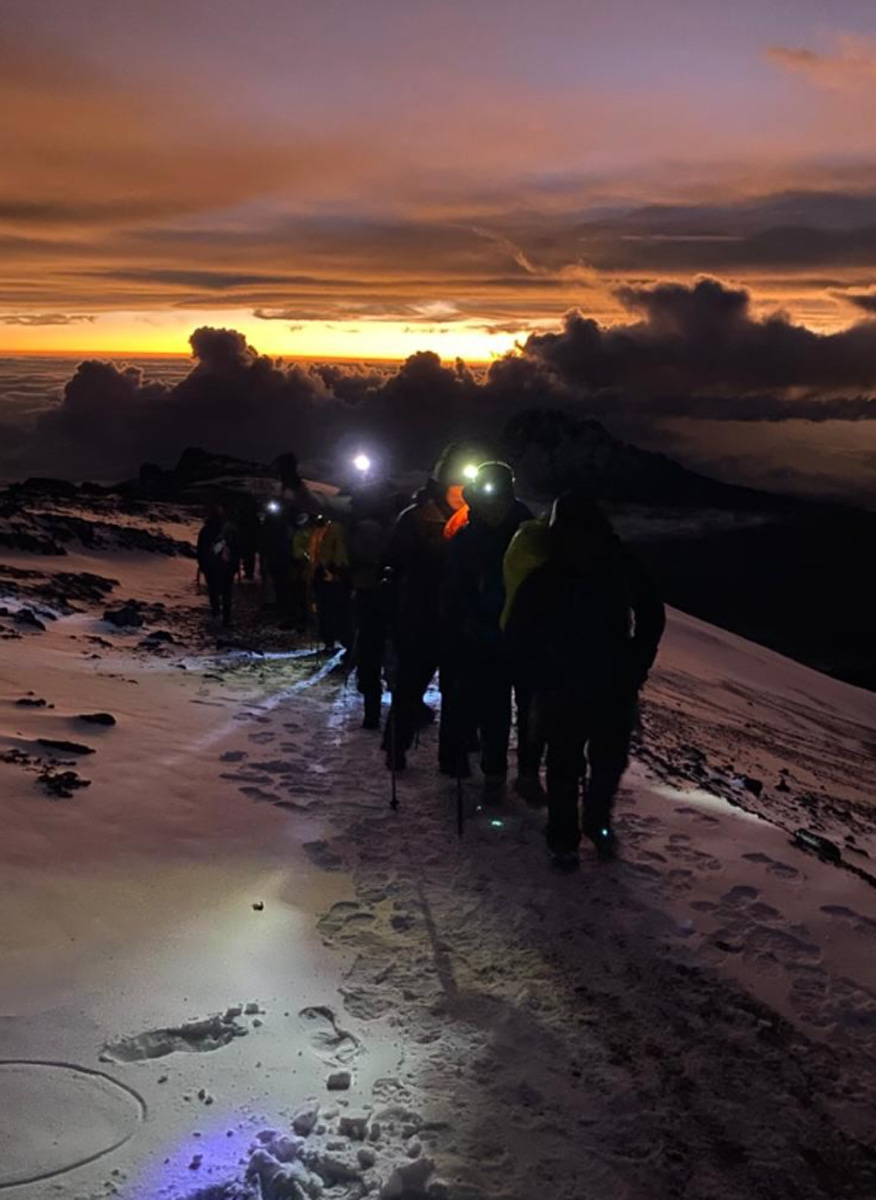
Around midnight, the guide comes to the tent. The zip opens and the cold comes in immediately, sharp and total. Outside, headlamps are already moving between tents. The group assembles quietly in the dark, pulls on gloves and buffs and extra layers, and then — almost without ceremony — the walk begins. De porters start packing your bagage and taking the tents down again. They are going down with that. We are going up.
The first thing that strikes most people is how little they can see. The headlamp throws a small cone of light onto the path ahead, enough for the next few steps, no more. Beyond that edge there is only the mountain and the night. Conversations trail off quickly.
Within the first half hour the group has stretched into a loose line, each person settling into their own pace, their own breathing, their own private version of the climb. The guide walks ahead, unhurried, setting a rhythm so slow it feels almost like standing still — and that slowness, which might have felt frustrating on any of the earlier days, now makes complete sense.
Those who climb around full moon get something extra. On clear nights, the moonlight is so bright it renders headlamps almost unnecessary. The snow and glaciers above catch the light and throw it back — the summit glows white against the dark sky, close enough to seem within reach, far enough to keep you honest.
The path ahead stretches out in silver and shadow, and the mountain around you feels vast and still and oddly welcoming. It's one of the most beautiful things most climbers have ever seen, and they're seeing it at midnight, alone with their thoughts on the highest mountain in Africa.
The Long Middle
The trail to Stella Point is long in a way that has nothing to do with distance. The altitude slows everything — your legs, your thoughts, your sense of time. Some people count steps to pass the minutes. Others find a word or a phrase and repeat it with each footfall, a kind of moving meditation that carries them further than willpower alone would. The guide calls out pole pole — Swahili for slowly, slowly — at regular intervals, and by this point in the climb everyone understands exactly why.
What catches most climbers off guard up here isn't the cold, and it isn't even the altitude. It's the silence. Above 5,000 metres the mountain becomes extraordinarily quiet — no wind, often, no sound of other groups, nothing but your own breath and the soft crunch of boots on frozen ground. For people who live in cities and carry phones and rarely sit in a room without some kind of noise, this silence is something else entirely. It has a weight and a texture to it. It asks nothing of you except to keep moving.
"I remember thinking: I can't feel my fingers, my lungs are burning, and I have absolutely no idea how far I still have to go. And then I thought: this is the most alive I have ever felt." - Fabian
"I kept repeating one word with every step. Just one word. I still don't want to say what it was. But it worked." - Joris
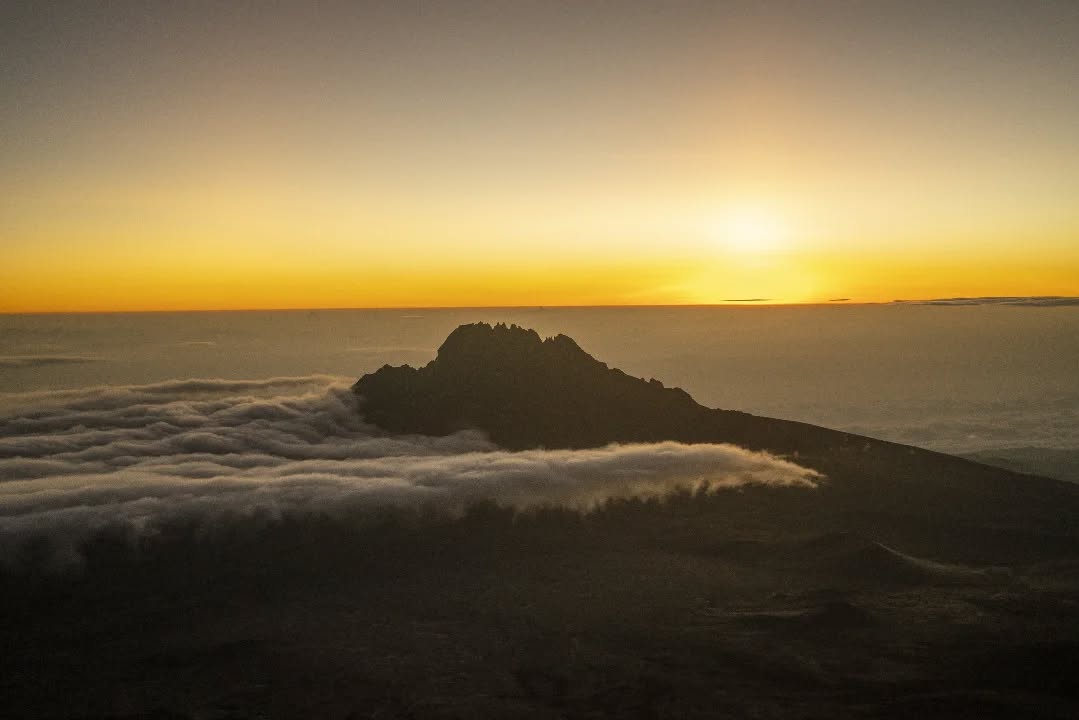
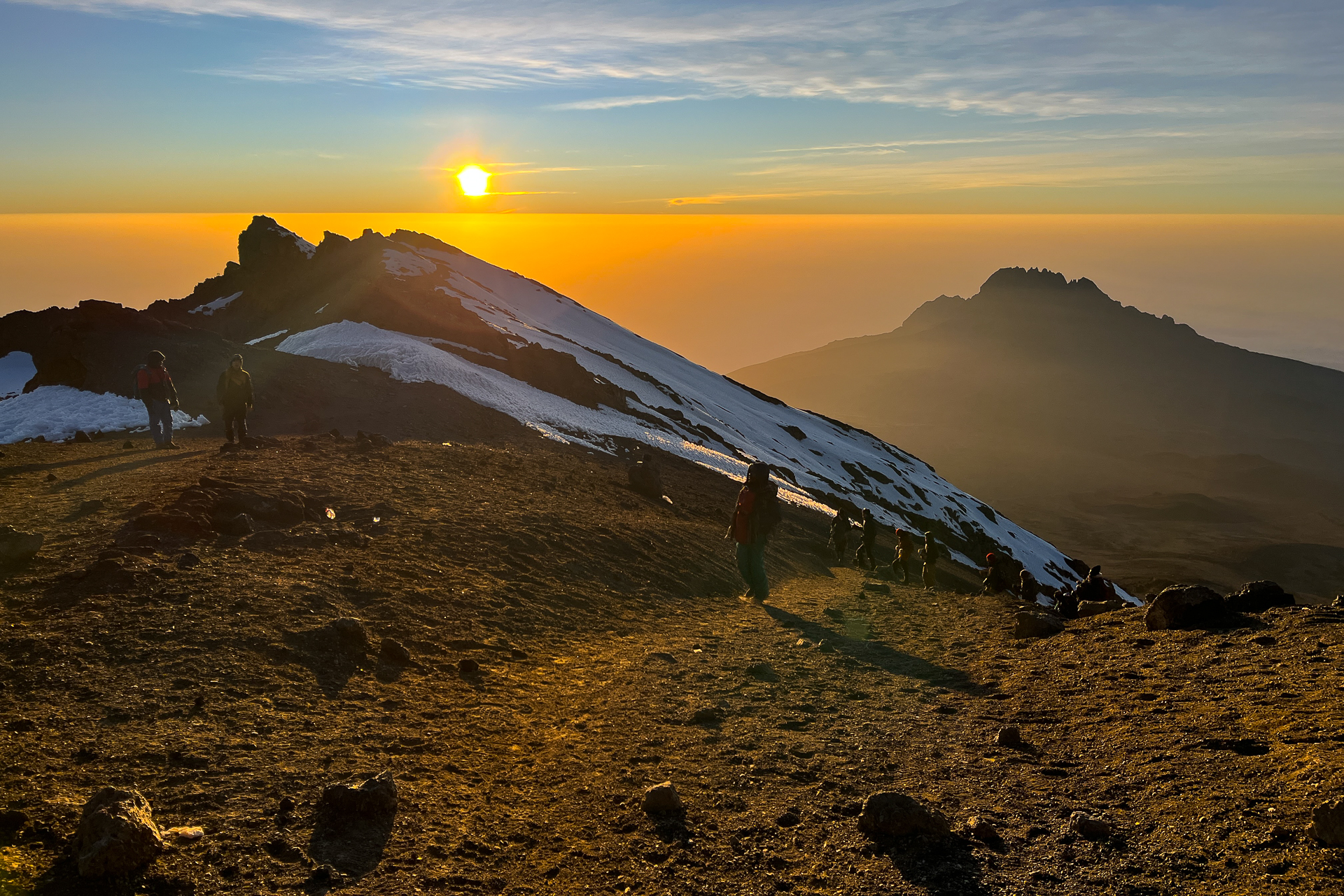
The sky begins to change somewhere in the final stretch before the crater rim. It happens slowly and then all at once — a deep blue gives way to violet, then a thin line of orange appears along the horizon far below, and you realize that you are watching the sun rise over Africa from somewhere most people will never stand. The clouds lie beneath you like a second ground. The world below is waking up and you are already above it.
Stella Point and the Final Ridge
Stella Point at 5,756 metres is the rim of Kilimanjaro's crater, and reaching it is a moment that hits people in different ways. Some cry. Some laugh. Some just stop and stand very still for a minute, looking at what the sky is doing, not quite ready to speak. The hardest climbing is behind you now. Ahead lies a ridge walk of around forty minutes along the crater's edge to Uhuru Peak — still at altitude, still demanding, but bathed now in the pale gold of early morning light.
The glaciers along the crater rim are enormous — walls of ancient ice that have been here far longer than any of us, scarred and blue-white and startling in their size. Walking past them in the early morning, with the sunrise happening around you and the whole of Tanzania spread out far below, is one of those moments that lodges itself permanently somewhere in the memory. Many climbers say they think about it still, years later, in ordinary moments when they least expect it.
Uhuru Peak
The summit arrives without fanfare — a wooden sign, a small flat area, the glaciers close by. But the feeling that accompanies it is anything but small. After the long night, the cold, the silence and the slow accumulation of steps, you are standing at 5,895 metres on the roof of Africa, in the early morning light, with the world below you in every direction.
The emotions vary from person to person. Some feel overwhelming joy. Some feel a deep, quiet satisfaction that doesn't need expression. Some feel surprisingly little in the moment itself — the altitude and the exhaustion and the cold see to that — and only understand the full weight of what they've done hours later, or days later, or when they're back home and someone who wasn't there asks them what it was like.
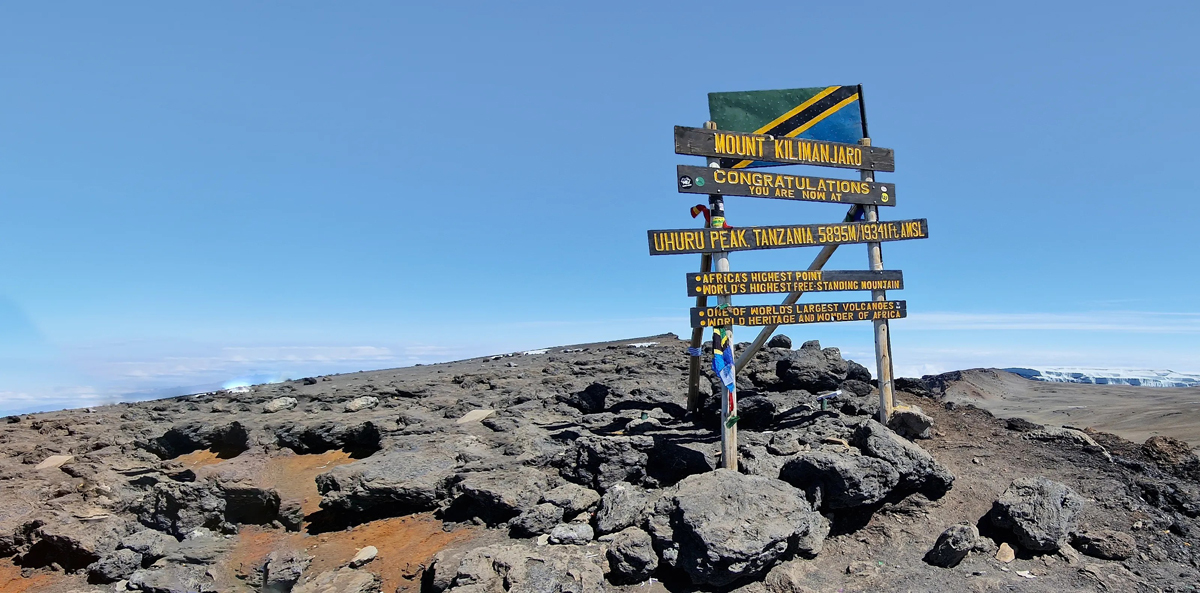
Fingers that are too cold to work the camera properly. A photo taken by someone else because your hands won't cooperate. A few minutes of standing there, looking, trying to take it in. Then the guide gently says it's time to head down, and you know he's right, and you take one more look before you turn.
⏱️ How long at the top?
Most groups spend between ten and twenty minutes at the summit. The altitude, the cold, and the long descent still to come mean you can't linger. But those twenty minutes are enough. The mountain has been building to this point for eight days — somehow, twenty minutes at the top holds all of that.
The Descent
Going down is where the body finally presents its bill. The adrenaline that carried you through the night begins to thin, and you feel every hour of the climb in your legs — particularly in your knees, which will remind you of the descent for a day or two afterwards. The trail from the summit back to Barafu is loose scree in places, and tired legs on steep ground demand a different kind of concentration than the slow upward trudge did.
From Barafu the descent continues — another 1,500 metres down through the alpine desert, back through the heathland, the air growing gradually thicker with each step and the body responding to it with something close to relief. The colours of the landscape change around you. The world becomes green again. By the time Mweka Camp appears in the late morning, the summit feels both recent and distant at the same time, the way vivid things sometimes do.
That Morning at Mweka Camp
At Mweka Camp, the group comes back together. Someone makes tea. People find a place to sit in the sun, boots off, faces turned upward. There isn't much talking, but it's a comfortable quiet — the kind that comes from having shared something that doesn't need to be narrated right away. It will be narrated, many times, in the months and years that follow. But for now, sitting in the morning light at Mweka Camp after a night like that, just being there is entirely enough.
Tomorrow is the last walk down through the rainforest to Mweka Gate, and then Arusha, and then the journey home. But all of that is tomorrow. Right now, the mountain is behind you and the sun is warm and you have just done something that will quietly change how you think about yourself for the rest of your life.
