
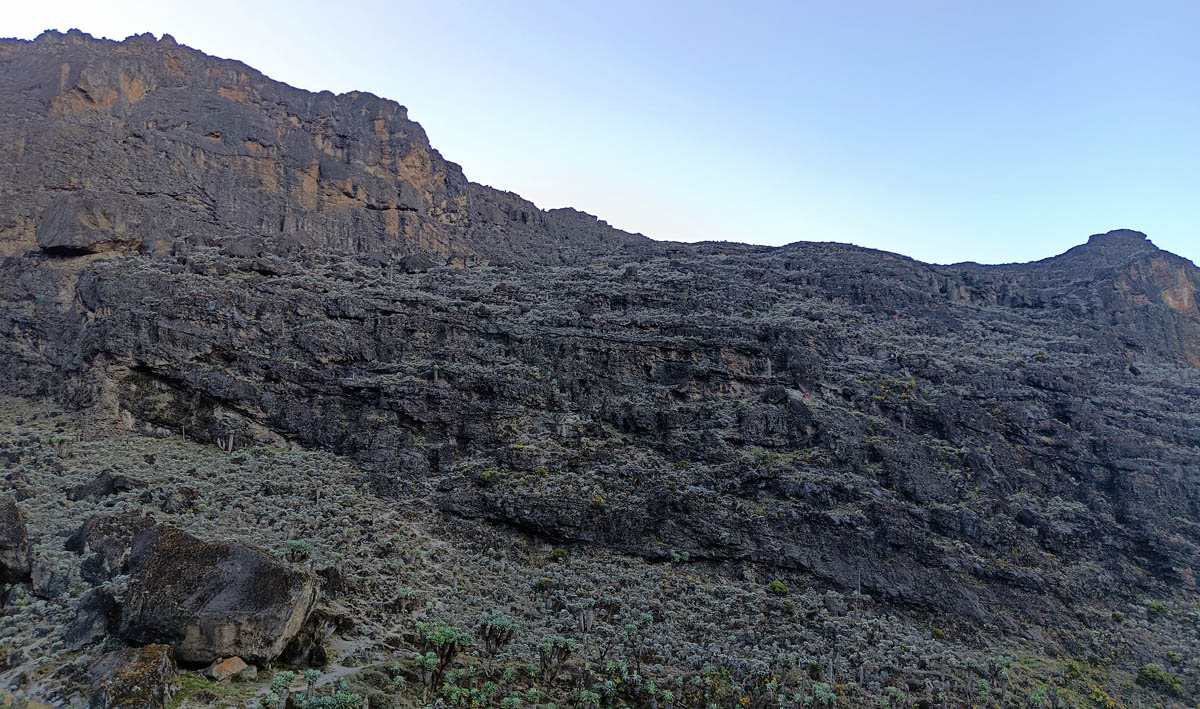
From Barranco Camp, you can see it. It rises almost vertically above the camp — a dark, jagged wall of rock several hundred metres high, filling the view to the east like something that was placed there specifically to test you. Most people look at it over their morning coffee and say very little. There isn't much to say. You're going up that.
The Barranco Wall is the moment that lives longest in the memory of almost everyone who climbs the Machame Route. Not because it's the hardest thing on the mountain — it isn't, not even close — but because of the distance between what it looks like from below and what it actually feels like to climb it. That gap is the whole story of Day 6.
The Evening Before
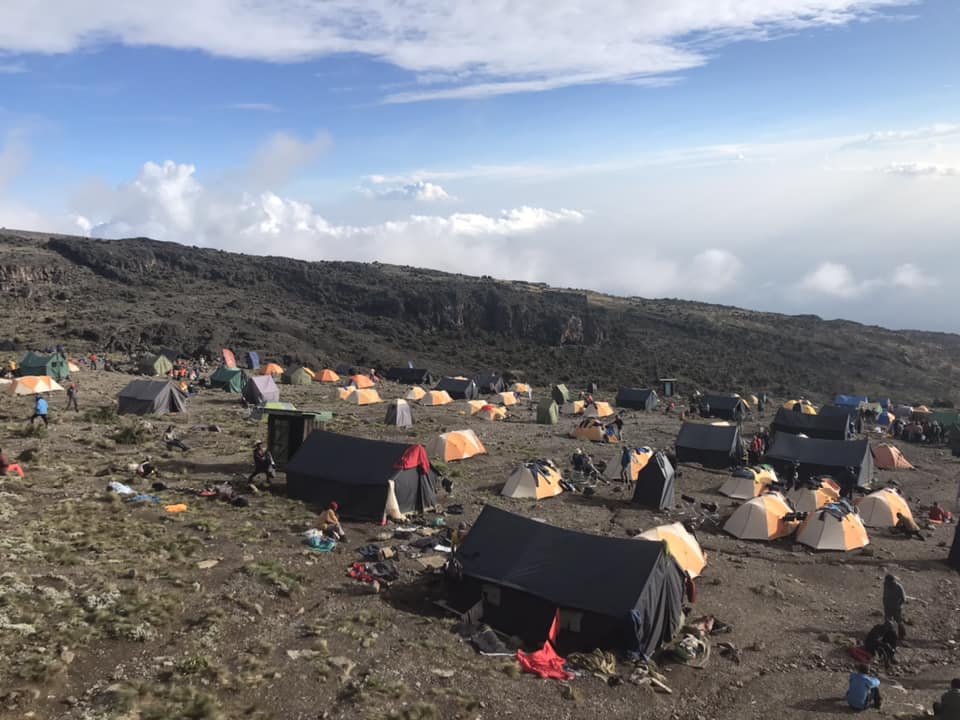
Day 5 brings you to Barranco Camp via Lava Tower — a long, altitude-testing day that leaves most people tired in a bone-deep way. Camp sits at around 3,900 metres, in a valley of giant senecio trees that look prehistoric and slightly improbable, their thick trunks topped with crowns of silvery leaves. It's a beautiful place to spend a night, and the beauty helps, because the wall is right there whenever you look up.
Over dinner in the mess tent, the wall comes up in conversation. The guides are relaxed about it — almost deliberately so. They've seen this particular anxiety hundreds of times. They describe the route, point out where the path goes, explain that hands will be needed in places but that there's nothing genuinely dangerous about it. People listen carefully and nod and then look out of the tent at the darkening rock face above them.
💡 What the guides know that you don't yet
The Barranco Wall looks vertical from below because of the angle and the scale. Once you're on it, the path reveals itself step by step — it winds and zigzags and uses ledges and gullies that are completely invisible from the camp. The guides have brought hundreds of climbers up this wall. In all that time, it has never been the thing that stops anyone.
The Morning
Breakfast is earlier than usual. The wall is best climbed before the sun hits it fully and the rock warms up — and besides, the sooner you start, the sooner the thing that's been occupying your thoughts since yesterday afternoon is behind you.
The approach from camp takes about twenty minutes, a gentle walk across the valley floor that gives you time to look up at the wall and feel whatever you're going to feel about it. Some people go quiet. Some talk more than usual. The porters, who carry the bags up a different, less technical path and somehow always arrive at the top first, move with the unhurried ease of people for whom this is simply another Tuesday.
On the Wall
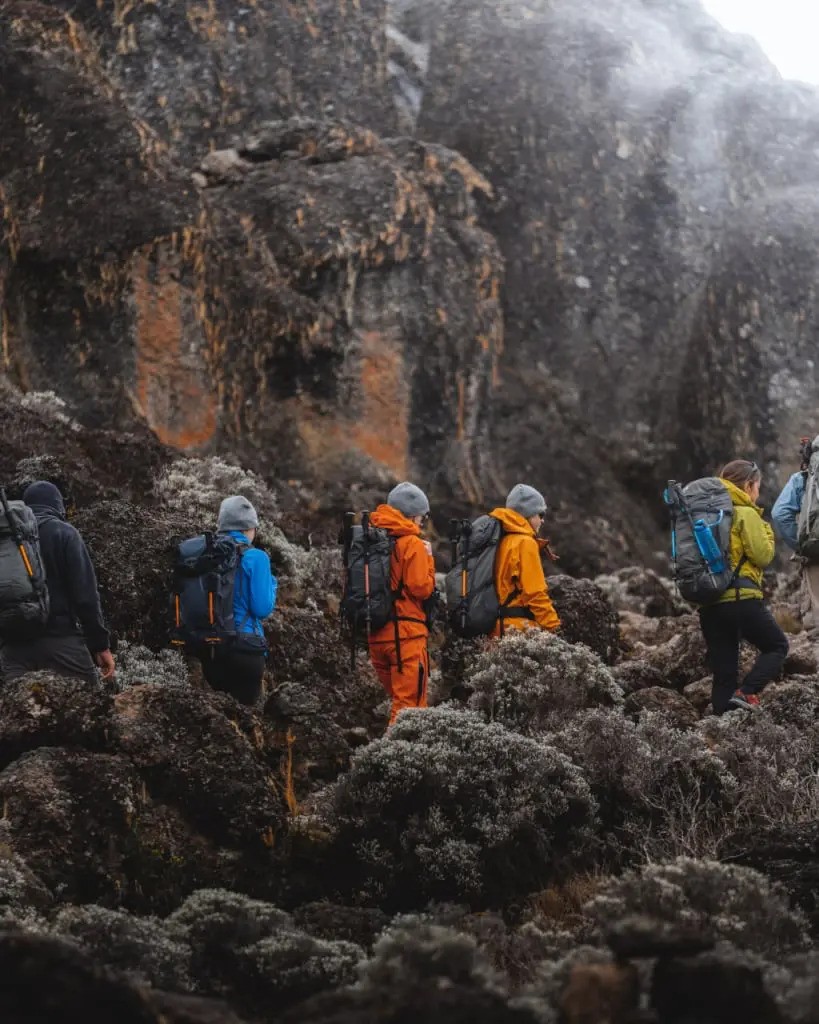
The moment the climbing begins, something shifts. The path is immediately more engaging than anyone expected — hands on rock, body close to the mountain, the whole thing demanding enough attention that there's no room left for anxiety. You're too busy looking for the next handhold, the next foothold, the next place to push up from. The wall, which looked blank and impassable from a distance, turns out to be full of features.
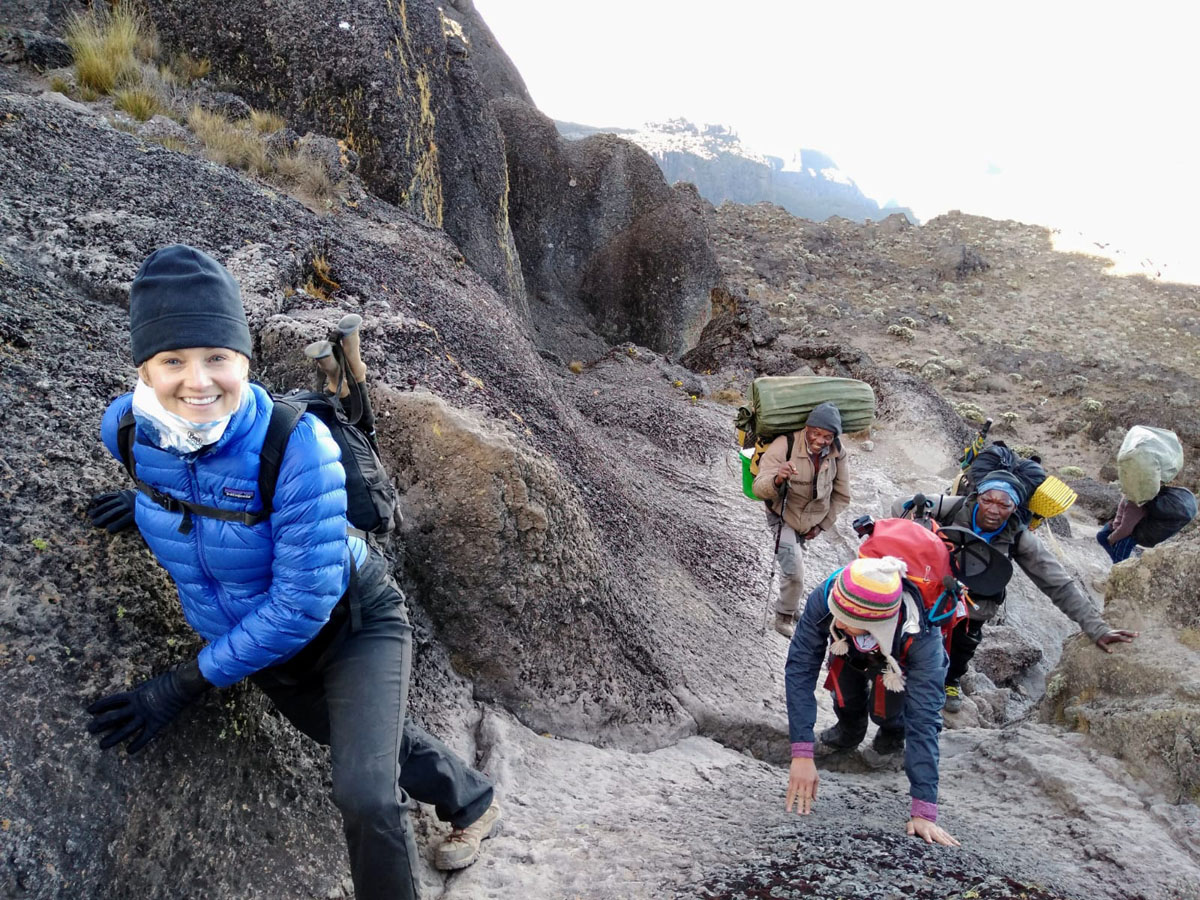
The route winds its way up through a series of ledges and gullies, never more than mildly technical, always manageable. The guides position themselves at the tricky moments — a hand offered here, a word of direction there — but nobody needs to be carried up. What people discover, usually within the first fifteen minutes, is that this is less like rock climbing and more like a very steep, very engrossing walk.
The views open up quickly. With each metre gained, the valley below drops away and the panorama of the southern slopes comes into view — Kilimanjaro's glaciers above, the heathland falling away below, and the long ridgeline of the route you've already walked stretching back behind you. People stop at the wider ledges not because they need to rest but because the view demands it.
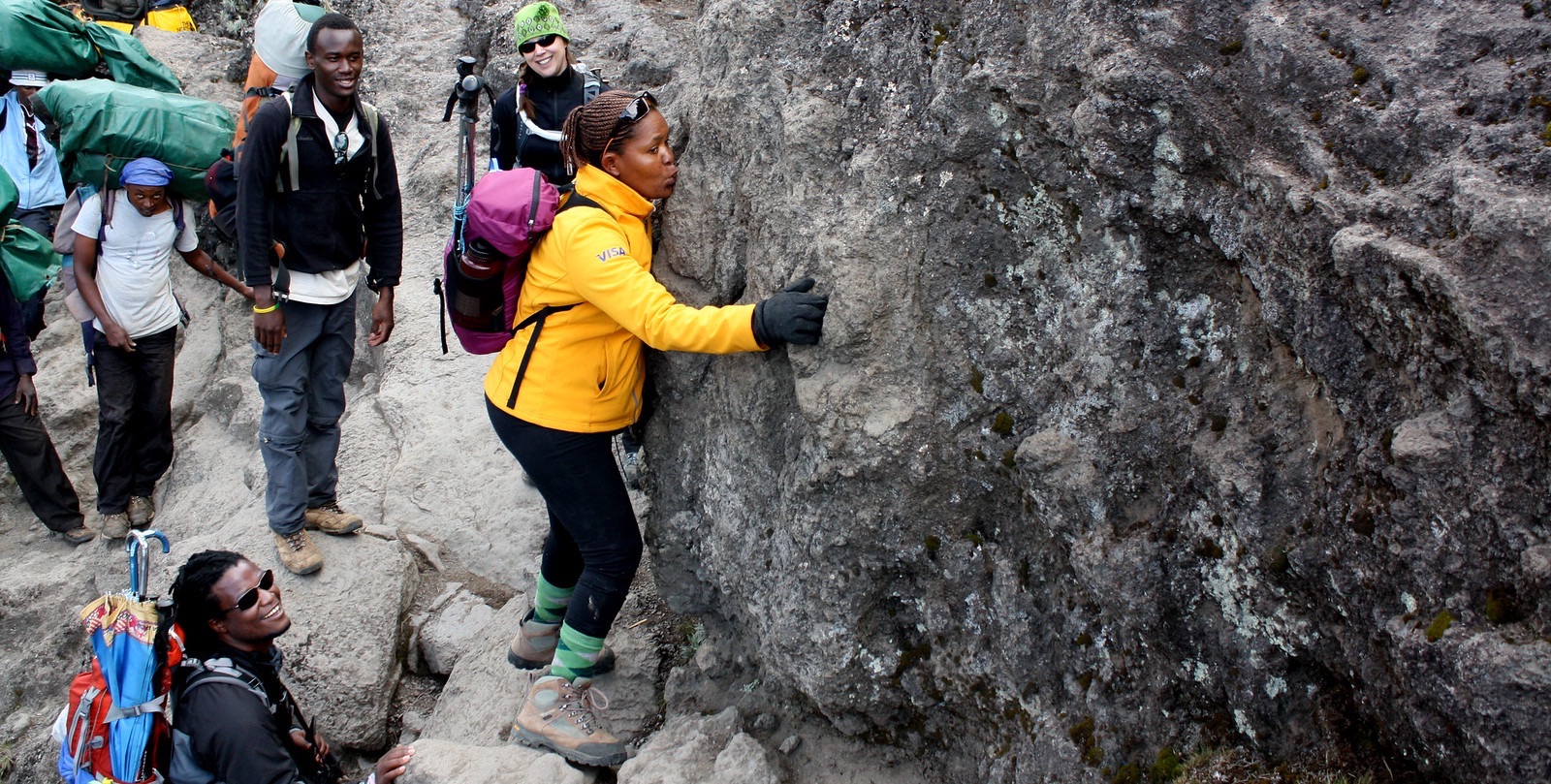
"I was completely convinced I wouldn't be able to do it. I'd been awake half the night worrying. And then we started climbing and I thought — wait, this is actually fun? When we got to the top I burst out laughing. I don't really know why. It just came out." - Juliana
"The hardest part was the ten minutes before we started. Once we were moving, it was fine. More than fine." - Bernice
The Top of the Wall
The summit of the Barranco Wall — not to be confused with the summit of the mountain, which is still two days away — arrives without a dramatic final move. The angle eases, the path broadens, and suddenly you're standing on a wide rocky plateau looking back down at Barranco Camp far below and ahead at the long ridge that leads towards Karanga. The thing you were afraid of is behind you, and it took less than an hour.
This is a particular kind of satisfaction that the mountain offers several times in the course of eight days — the satisfaction of having done something that seemed impossible from the outside and straightforward from the inside. The wall is perhaps the clearest version of it, because the gap between the two perspectives is so stark.
The Rest of Day 6
What follows the wall is one of the more enjoyable sections of the entire route. The path traverses a series of rolling ridges above the clouds, the terrain open and dramatic, the walking steady but not punishing. Karanga Camp is visible in the distance long before you reach it, tucked into a fold in the hillside at around 3,960 metres.
The mood in the group on this stretch is noticeably lighter than it has been. The wall is done. The summit is two days away. The altitude is high but manageable. People talk more, look around more, take more photos. The mountain feels less like an opponent and more like a place you're getting to know.
Karanga Camp is reached well before late afternoon, which means an unusual luxury: time. Time to wash, to rest properly, to sit outside the tent and watch the clouds move below. After the packed days that preceded it, an afternoon with nothing required of you feels like a small gift.
What the Wall Actually Is
People who've done the Machame Route almost always mention the Barranco Wall when they talk about it afterwards. Not as the hardest part, but as the most memorable one. The story has a clean shape — the fear, the climb, the surprise — and it tends to stick.
But there's something else the wall does that matters more than the story. It shows you, concretely and unmistakably, that your assessment of what you're capable of is probably too conservative. That the thing you were sure would stop you didn't. That the mountain has been quietly expanding your sense of yourself since Day 3, and that this is just the most visible moment of that process so far.
The summit is still two days away. But somewhere on that wall, without quite noticing it, most people start to believe they're going to make it.
